Does Recycled Aluminium Really Cut Scope 3 Emissions?
21 Views |
If your company uses 10 tonnes of aluminium profiles a year, switching to recycled aluminium cuts your Scope 3 CO₂ by about 83–122 tonnes a year, with no change to your part design.
Today, end customers, investors and export markets no longer ask only about the carbon inside your factory. They ask about your whole supply chain. Many companies have already installed solar panels and energy-efficient machines, but have not yet touched the materials they buy.
We faced this ourselves at LIXIL. When we surveyed Scope 3 across the group, virgin aluminium ingot turned out to be the largest single carbon source. That finding is where PremiAL began: recycled aluminium produced in Thailand at Tostem Thai.
This article explains what Scope 3 is, why aluminium is so carbon-intensive, and how to calculate how many tonnes your company could cut.
What is Scope 3? (the simple version)
Under the GHG Protocol, an organisation's greenhouse gas emissions fall into three scopes:
Scope 1 : direct emissions from your organisation, such as fuel burned in your factory
Scope 2 : emissions from the electricity and energy you buy
Scope 3 : emissions across your supply chain, both upstream and downstream
The aluminium you buy to make your products sits in Scope 3, Category 1 (purchased goods and services). For parts manufacturers, metal raw materials are often a large share of this category, which makes them a place where reductions show results quickly.
In construction, carbon from materials is called embodied carbon. According to the Global Alliance for Buildings and Construction (2021), the building sector accounts for about 37% of global emissions, and around 30% of that comes from embodied carbon. As buildings become more energy-efficient, embodied carbon matters even more.
Why aluminium is so carbon-intensive
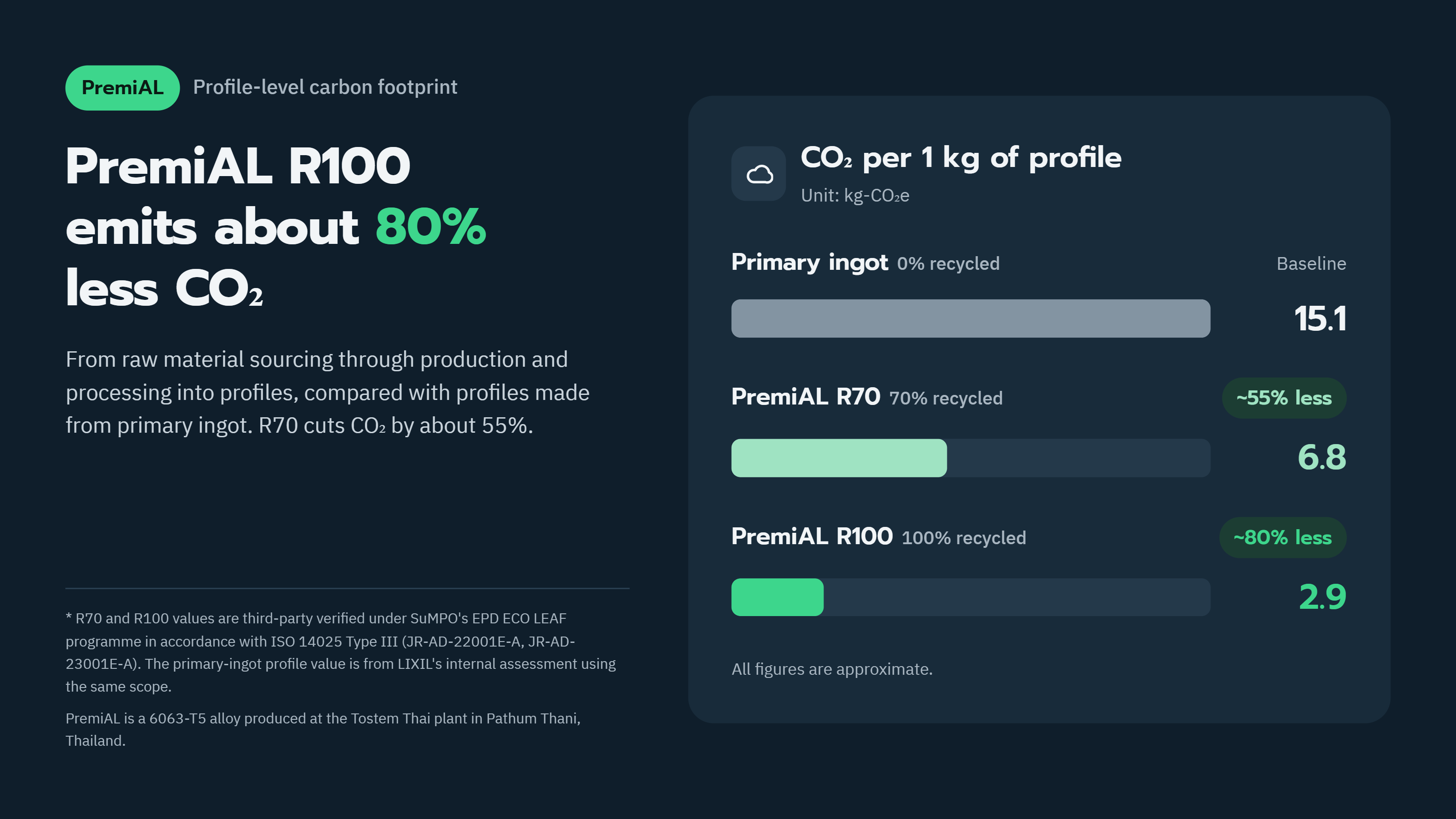
Almost all of aluminium's carbon is emitted during smelting. Making new aluminium means turning bauxite ore into alumina, then separating the metal with enormous amounts of electricity. Recycled aluminium is simply scrap remelted, so it skips the heaviest step entirely.
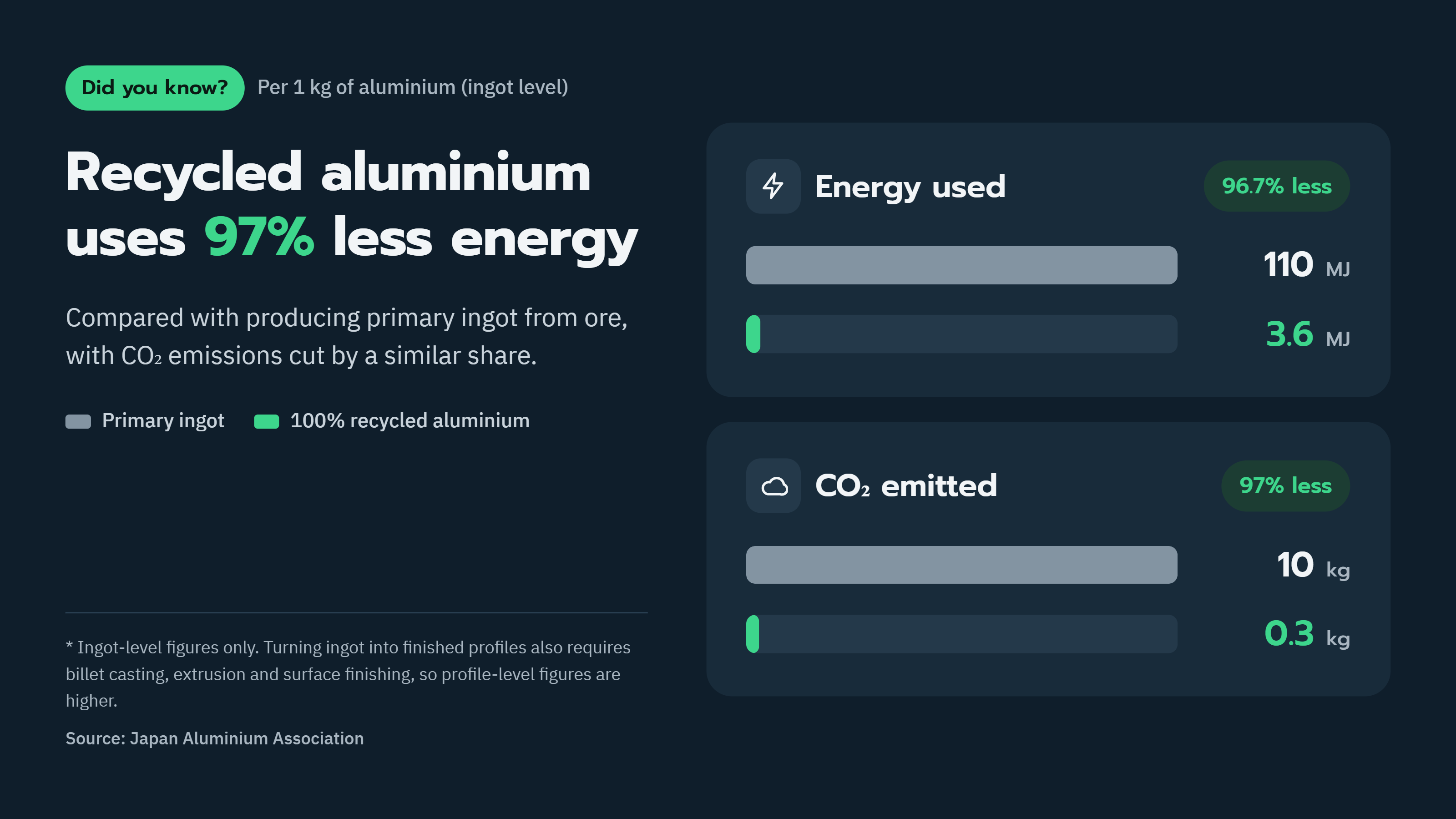
PremiAL carbon values at profile level
Measured from raw material sourcing through production and processing into a profile, PremiAL R70 emits about 55% less CO₂ than a profile made from virgin ingot, and R100 about 80% less.
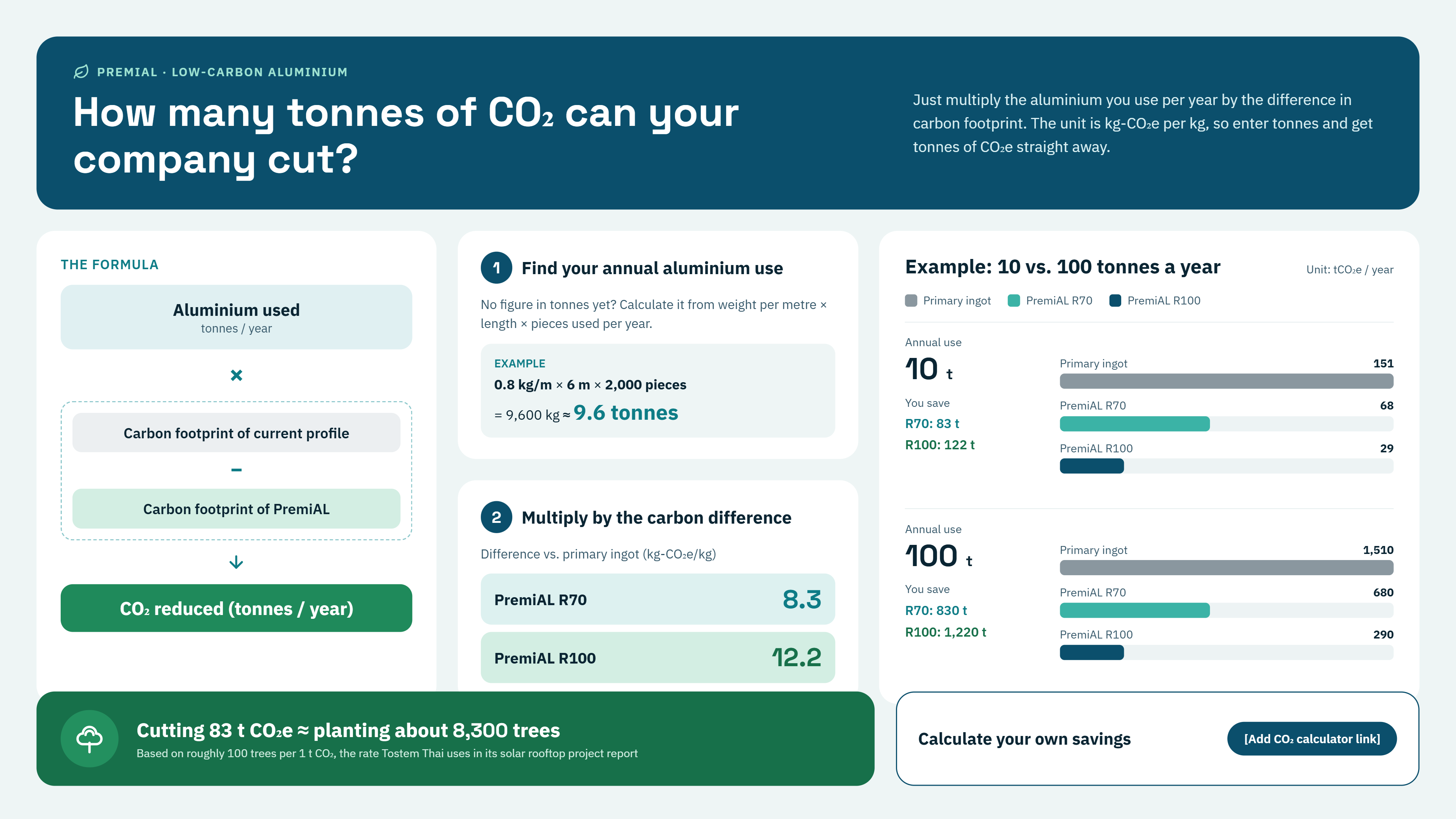
How to calculate how much your company can cut?
The formula needs only your annual aluminium volume multiplied by the difference in carbon values. Because the unit is kg-CO₂e per kg, entering volume in tonnes gives the result directly in tonnes of CO₂e.
CO₂ reduced (t/year) = aluminium used (t/year) × (carbon value of current profile − carbon value of PremiAL)
Step 1: Find your annual aluminium volume. If you don't have a tonnage figure, calculate it as weight per metre × length × quantity used per year. For example, a profile weighing 0.8 kg/m, 6 m per bar, 2,000 bars a year = 9,600 kg, or 9.6 tonnes.
Step 2: Multiply by the difference in carbon values. R70 is 8.3 kg-CO₂e/kg lower than virgin ingot, and R100 is 12.2 kg-CO₂e/kg lower.
Example: 10 tonnes and 100 tonnes of profiles a year
Lower carbon, same quality
The number one concern about recycled aluminium is quality. Tests comparing PremiAL with standard profiles show equal results in three areas:
Chemical composition: Si, Mg and Fe are within the JIS standard range for 6063 alloy
Mechanical properties: Vickers hardness meets the JIS requirement (at least Hv58 for 6063-T5), close to profiles made from virgin ingot
Colour after finishing: differences in brightness and vividness stay within the controlled range
Behind this is strict material sorting. Scrap aluminium windows often come with steel screws and zinc handles attached. High-performance sorting machines in the Sash-to-Sash process remove these parts, and LIXIL's casting technology then controls the alloy composition before extrusion and surface treatment.
Who benefits most?
Exporters to Europe and overseas customers: the EU's CBAM covers aluminium products, and overseas buyers are starting to ask for carbon data on the parts they purchase.
Companies with SBT or Net Zero targets: they need to show a measurable Scope 3 reduction plan, and switching materials delivers a clear number.
Japanese-affiliated and multinational companies in Thailand: parent companies often set carbon targets for the whole supply chain.
Building owners and designers: cut a building's embodied carbon, with an EPD to support green building certification.
[Request a PremiAL quotation]
- Tel +66 2-529-0475 ext. 1839
- Email sale_division@lixil.com
- LINE OA: @tostemthai.oem


